
Choose the Starting Point That Matches Your Child
Many parents do not need another random worksheet first. They need a clear starting point. If your child may be weak in ELA revising and editing, start with the free grammar sample. If you need a broader baseline, use one SHSAT-style diagnostic. If you already know the weak spots, move into the 4-week sprint.
The useful order is simple: sample, diagnose, map, practice. That keeps summer prep from becoming a folder full of PDFs with no next step.
Step 1: Try a Focused Grammar Sample
Revising and editing is one of the easiest SHSAT areas for parents to inspect quickly. A short grammar sample can show whether the student notices sentence structure, punctuation, transitions, clarity, and concise wording.
Use the free sample as a low-friction check. If it feels too easy, move to the diagnostic. If it exposes errors, the family already has a concrete skill to practice before fall.
Step 2: Use One Diagnostic to Find the Full Pattern
A rising Grade 8 student needs one serious baseline before a family buys more practice. The diagnostic should include both ELA and math so parents can see whether the issue is reading evidence, revising and editing, word-problem setup, algebra, geometry, grid-ins, pacing, or careless mistakes.
Do not treat the score as a final prediction. Treat it as a map. Mark missed questions, guessed questions, and slow questions. Guessed-correct questions matter because they show unstable skills.
Step 3: Turn Misses Into a Weak-Spot Map
A raw score does not tell parents what to do tomorrow. A weak-spot map does. Sort ELA misses into reading evidence, inference, vocabulary in context, revising and editing, and stamina. Sort math misses into algebra, ratios, geometry, word problems, grid-ins, pacing, and careless errors.
Once the pattern is visible, choose only two or three weak spots for the next week. A narrow plan is more useful than a heroic plan that tries to fix everything at once.
Step 4: Build a Four-Week Summer Rhythm
For most families, a 15 to 25 minute practice block is easier to sustain than a long daily cram session. A good block has three parts: complete a small set, score it, then write down why each miss happened.
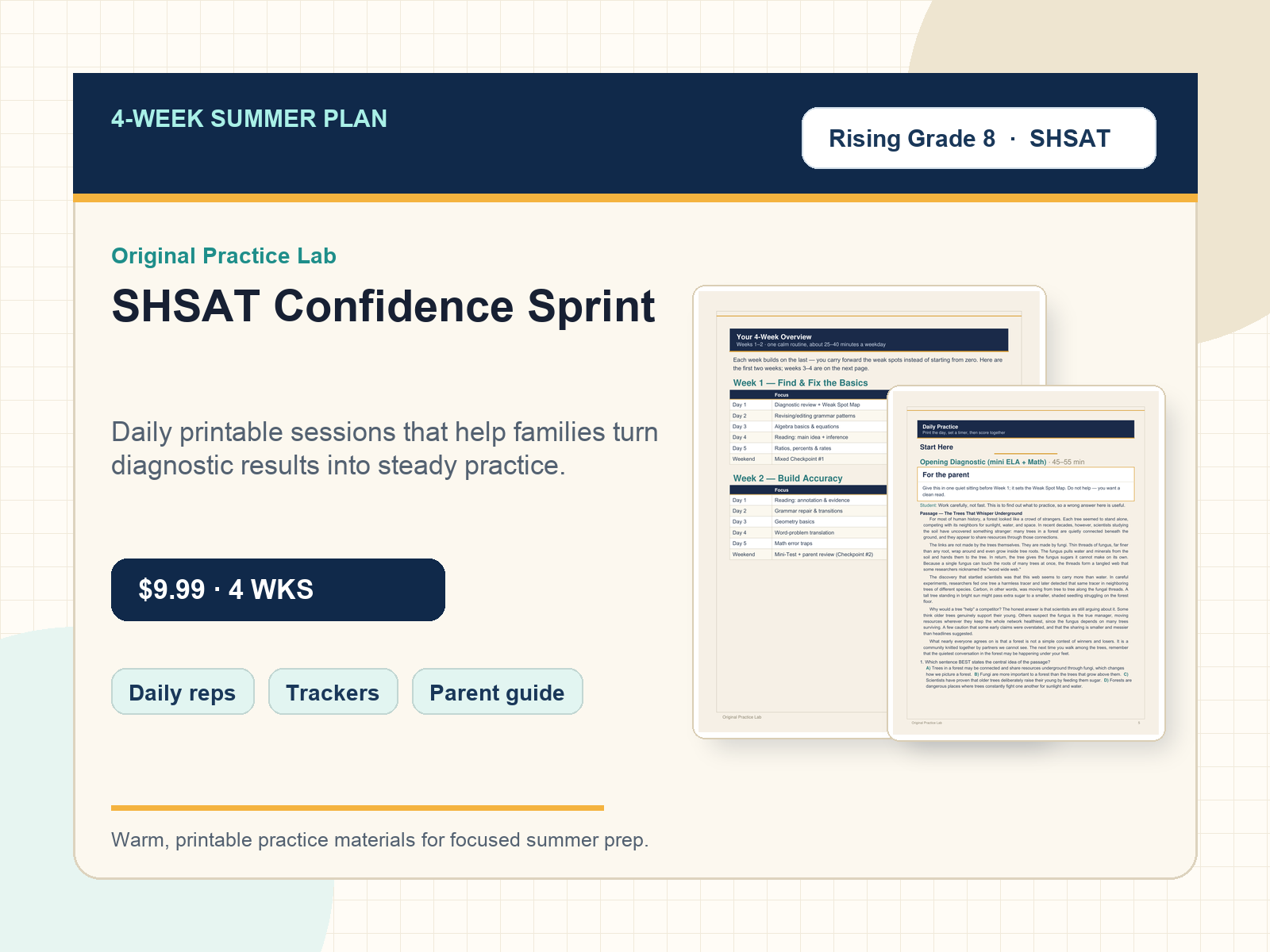
Week 1 should identify the pattern. Week 2 should fix the biggest basics. Week 3 should mix skills and pacing. Week 4 should review recurring errors and rebuild confidence before fall.
What to Buy, and When
Start free if you only need to inspect the format or check one ELA skill. Buy the $1.99 diagnostic if you want a complete baseline without committing to a larger workbook. Use the 4-week sprint if your child needs a structured daily plan after the weak spots are known.
Choose the paperback workbook if you want the diagnostic, tracker, and sprint in one printed object that can stay on a desk all summer. Choose PDFs if you want the lowest-cost path and can print at home.
Why This Path Works Better Than Random Practice
Random practice can create effort without direction. A parent may see pages completed, but still not know whether the child is improving in evidence, grammar, algebra setup, geometry, grid-ins, or pacing.
A summer path should make the next action obvious. If grammar is weak, practice grammar. If the full diagnostic shows math setup errors, practice word-problem translation. If the child loses points late in the test, practice stamina and review habits.
What to Avoid During Summer SHSAT Prep
Avoid downloading five unrelated PDFs before reviewing the first one. Avoid repeating full practice tests every few days without fixing the errors. Avoid treating one summer score as a final prediction.
A better parent question is: after this week, can my child explain the kinds of mistakes they are making and what they are practicing next? If yes, the summer plan is doing its job.