The Parent Problem: Where Do We Start?
Many NYC parents start summer SHSAT prep by searching for free PDFs, workbooks, or tutoring options. That is understandable, but it can create a pile of materials before the family knows what the child actually needs.
A better first week has one goal: make the next step obvious. Instead of asking whether your child is ready for the SHSAT, ask which two skills should drive the next week of practice.
Before You Plan the Summer, Check the Current Test Context
NYC Public Schools is the source families should use for dates, eligibility, accommodations, and current test details. As of June 2026, the next SHSAT guide for a future administration is still being updated, so parents should avoid relying on old calendar screenshots or non-NYCPS date claims.
NYC Public Schools also says the SHSAT will move to a computer-adaptive format beginning in fall 2026. That does not make paper practice useless, but it changes the purpose: paper-style practice should be used to find weak spots, build stamina, and review ELA and math skills, not to pretend to reproduce the exact digital test experience.
Day 1: Take One Baseline Diagnostic
Start with one timed diagnostic or practice test that includes both ELA and math. The score is less important than the error pattern. A student who misses reading evidence questions needs a different plan from a student who loses points on revising and editing, algebra setup, or grid-in formatting.
For a rising Grade 8 student, a baseline should feel serious enough to reveal weak spots but not so overwhelming that the family avoids reviewing it. That is why a low-cost printable diagnostic can be useful before buying a larger prep book or signing up for tutoring.
Day 2: Sort Missed, Guessed, and Slow Questions
The day after the diagnostic, do not immediately assign another full test. First, mark three kinds of questions: missed questions, guessed questions, and slow questions. Guessed-correct questions matter because they reveal skills that are not yet stable.
Use the free SHSAT Weak-Spot Tracker to sort those questions into useful buckets. For ELA, look for reading evidence, inference, vocabulary, revising and editing, and stamina. For math, look for algebra, ratios, geometry, word-problem setup, grid-ins, careless errors, and pacing.
Day 3: Pick One ELA Weak Spot and One Math Weak Spot
The most common summer prep mistake is trying to fix everything at once. A cleaner plan is to choose one ELA weak spot and one math weak spot for the next few days.
For example, the ELA focus might be finding sentence-level evidence in reading passages. The math focus might be translating word problems into equations. Those two targets are easier to practice, score, and review than a vague command like do more SHSAT prep.
Days 4-6: Use Short Practice Blocks
A practical first-week routine is 20 to 40 minutes per day. Give one focused ELA set or one focused math set, score it quickly, and write down the reason for each miss. Keep the review short enough that the student can actually finish it.
The point is consistency. A rising Grade 8 student often improves faster from repeated short review cycles than from occasional long sessions that no one wants to score carefully.
Day 7: Decide Whether You Need a Bigger Plan
At the end of the first week, look at the weak-spot tracker again. If the misses are concentrated in one or two areas, continue with focused drills. If the misses are scattered across ELA and math, the family probably needs a more structured daily plan.
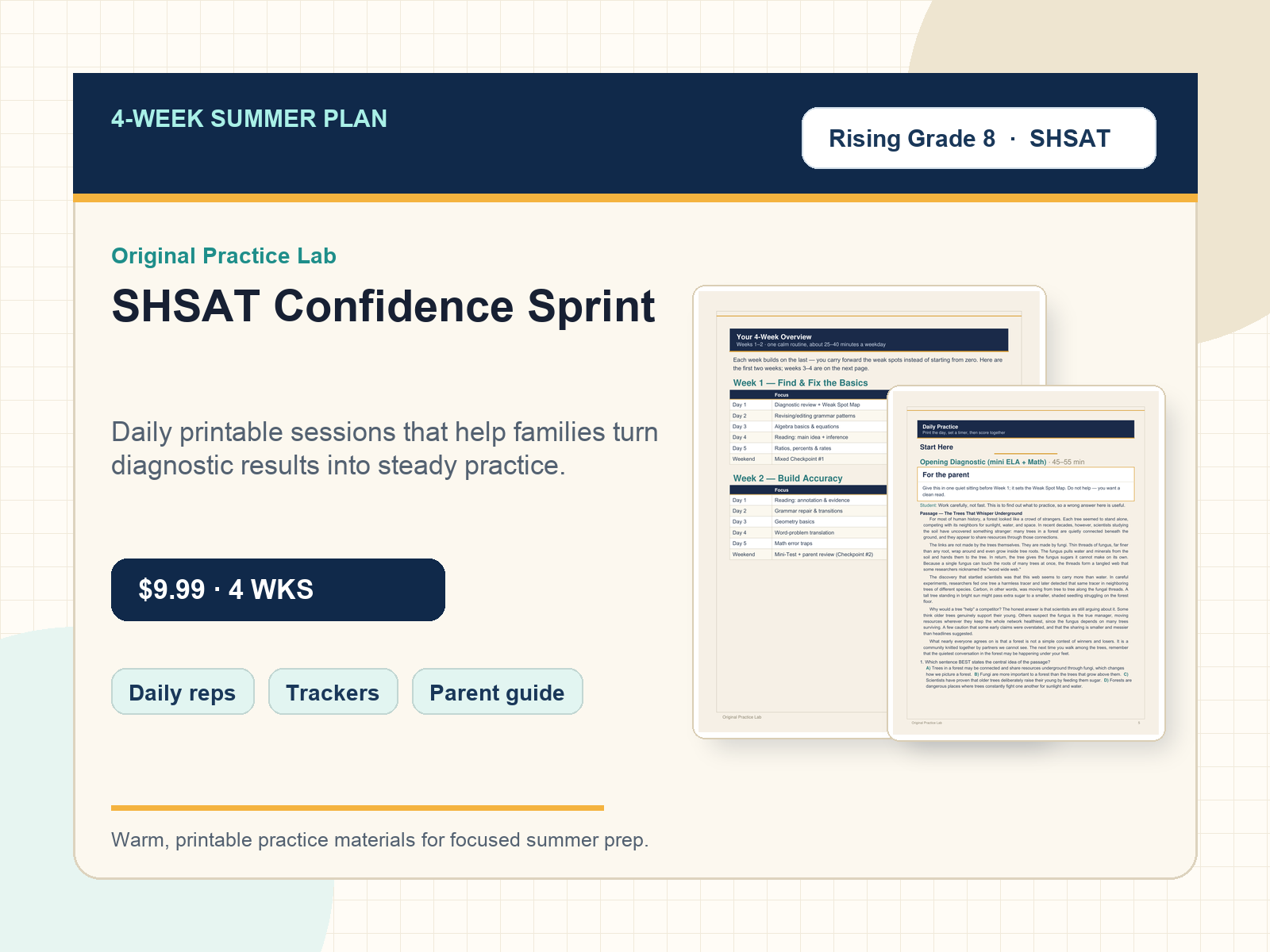
This is where the 4-Week Summer SHSAT Confidence Sprint fits. It is for families who do not want to decide from scratch every day and need a parent-guided path from diagnostic results to daily practice.
The Simple Sequence
The simplest summer SHSAT start is: one diagnostic, one weak-spot map, one week of focused ELA and math practice, then a decision about whether to continue with drills or a structured sprint.
That sequence prevents the two expensive mistakes: doing random worksheets that do not match the child's needs, or buying a large prep system before you know whether the main issue is ELA, math, pacing, or review habits.