Daily SHSAT mistake lab
SHSAT Daily Mistake #5: The Ratio Base Trap
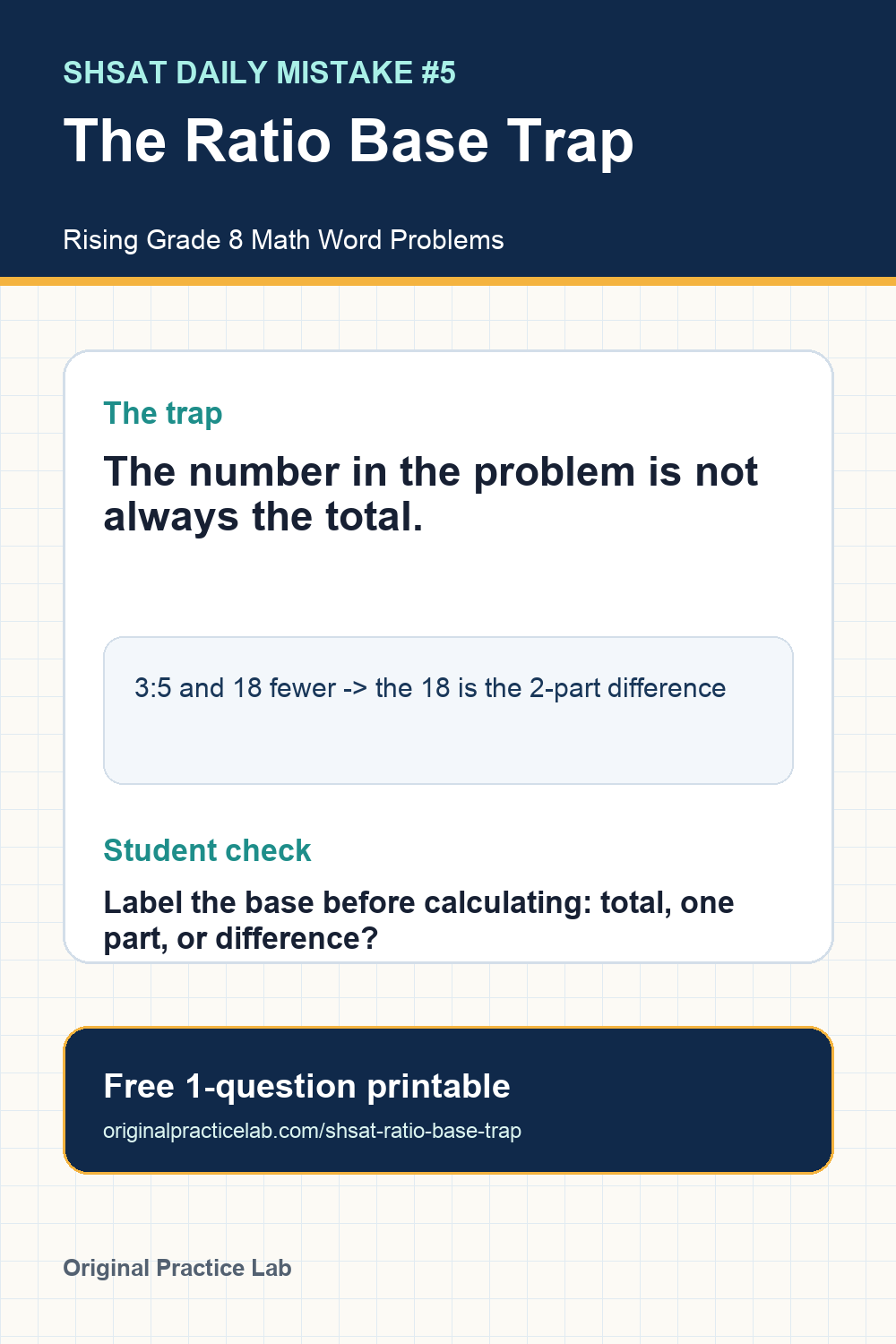
In ratio and percent problems, the number in the question is not always the total. Strong students first identify the base before calculating.
Free printable mini-lesson
Daily Mistake #5: The Ratio Base Trap
Print one SHSAT-style ratio question, let your child identify the base, then review why the tempting shortcuts fail.
- One focused ratio word-problem question
- Answer key with a parent-friendly explanation
- Next-step links to the free tracker and diagnostic
Download printable PDF
Why This Mistake Matters
Many SHSAT-style ratio and percent questions are not difficult because of the arithmetic. They are difficult because the student starts with the wrong base.
The trap is to treat the visible number as the total. In a ratio problem, a number such as 18 fewer may represent the difference between parts, not one group or the whole group.
The Student Move
Before calculating, have the student label what the number represents: total, one part, difference between parts, percent change, or remaining amount.
For ratio questions, draw the part boxes first. If the ratio is 3:5 and the difference is 18, then the two extra boxes are worth 18. One box is worth 9.
One-Question Practice
Question: In a school club, the ratio of boys to girls is 3:5. There are 18 fewer boys than girls. How many students are in the club?
Correct answer: 72.
Why: the difference between 5 parts and 3 parts is 2 parts. Those 2 parts equal 18, so 1 part equals 9. The total is 8 parts, and 8 x 9 = 72.
What to Watch For Next
If your child misses this kind of item, do not only review ratio formulas. Ask what the given number represents before any computation starts.
If ratio-base errors appear with percent-change or word-problem misses, use the free weak-spot tracker after the next practice set. If the weak spot is unclear, use the $1.99 diagnostic to map both ELA and math before choosing the next practice block.
Recommended next step
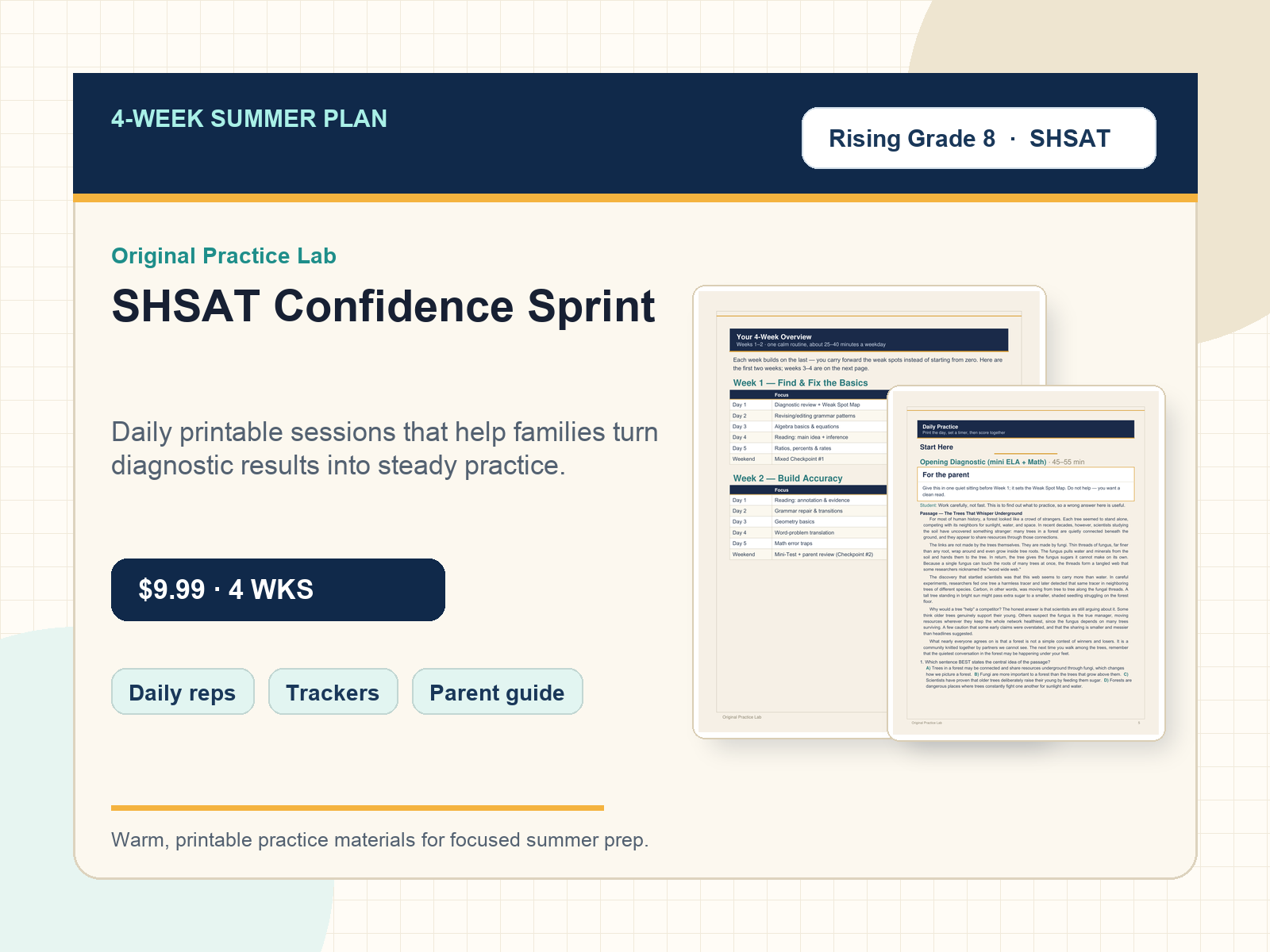
Use the Diagnostic First, Then Build a 4-Week Plan
For most families, the cleanest summer path is one printable diagnostic, followed by short daily ELA and math practice where the child actually needs it.
Questions Parents Ask
What is the ratio base trap?
It is the mistake of treating a number in the problem as the total when it actually represents one part, a difference between parts, or another base.
How should a rising Grade 8 student check this?
Label what the number means before calculating. In ratio problems, draw part boxes and match the given number to the correct boxes.
What should parents do after this mini-lesson?
Use a few focused ratio and percent word problems. If the student keeps choosing the wrong base, use the free tracker or the $1.99 diagnostic to see whether word-problem translation is the main weak spot.
Is this affiliated with SHSAT, NYC schools, or any test publisher?
No. Original Practice Lab creates independent practice materials with original questions. The materials are not affiliated with, endorsed by, or sponsored by any test publisher, school district, or testing organization.