Daily SHSAT mistake lab
SHSAT Daily Mistake #8: The Work-Rate Setup Trap
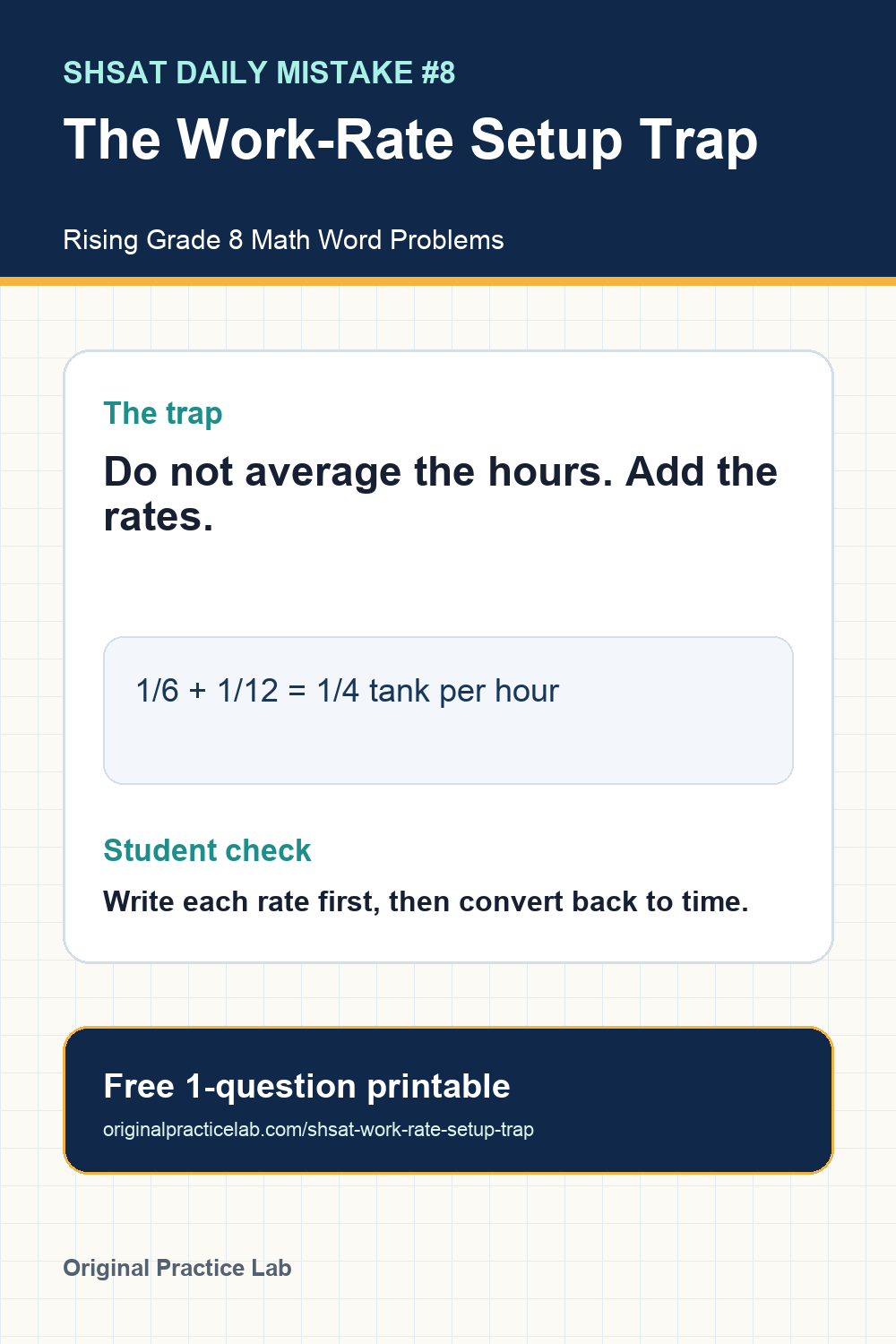
Work-rate questions are not solved by averaging the hours. Strong students convert each worker or pipe into a rate, add the rates, then convert back to time.
Free printable mini-lesson
Daily Mistake #8: The Work-Rate Setup Trap
Print one SHSAT-style work-rate question, let your child set up the rates first, then review why averaging the hours fails.
- One focused work-rate word-problem question
- Answer key with a parent-friendly explanation
- Next-step links to the free tracker and diagnostic
Download printable PDF
Why This Mistake Matters
Work-rate problems feel simple until a student combines times instead of rates.
The trap is to average 6 hours and 12 hours, or to add the hours together. The useful unit is not hours per tank. It is tanks per hour.
The Student Move
Convert each person, pipe, or machine into a rate: part of the job per hour.
Then add the rates. If the combined rate is 1/4 of the job per hour, the full job takes 4 hours.
One-Question Practice
Question: Pipe A can fill a tank in 6 hours. Pipe B can fill the same tank in 12 hours. If both pipes run together, how many hours will it take to fill the tank?
Correct answer: 4.
Why: Pipe A fills 1/6 of the tank per hour. Pipe B fills 1/12 of the tank per hour. Together they fill 1/6 + 1/12 = 3/12 = 1/4 of the tank per hour, so the full tank takes 4 hours.
What to Watch For Next
If your child misses this kind of item, ask whether they wrote a rate before solving. If not, the mistake is setup, not arithmetic.
If work-rate errors appear with ratio, percent, or grid-in misses, use the free weak-spot tracker after the next practice set. If the weak spot is unclear, use the $1.99 diagnostic to map both ELA and math before choosing the next practice block.
Recommended next step
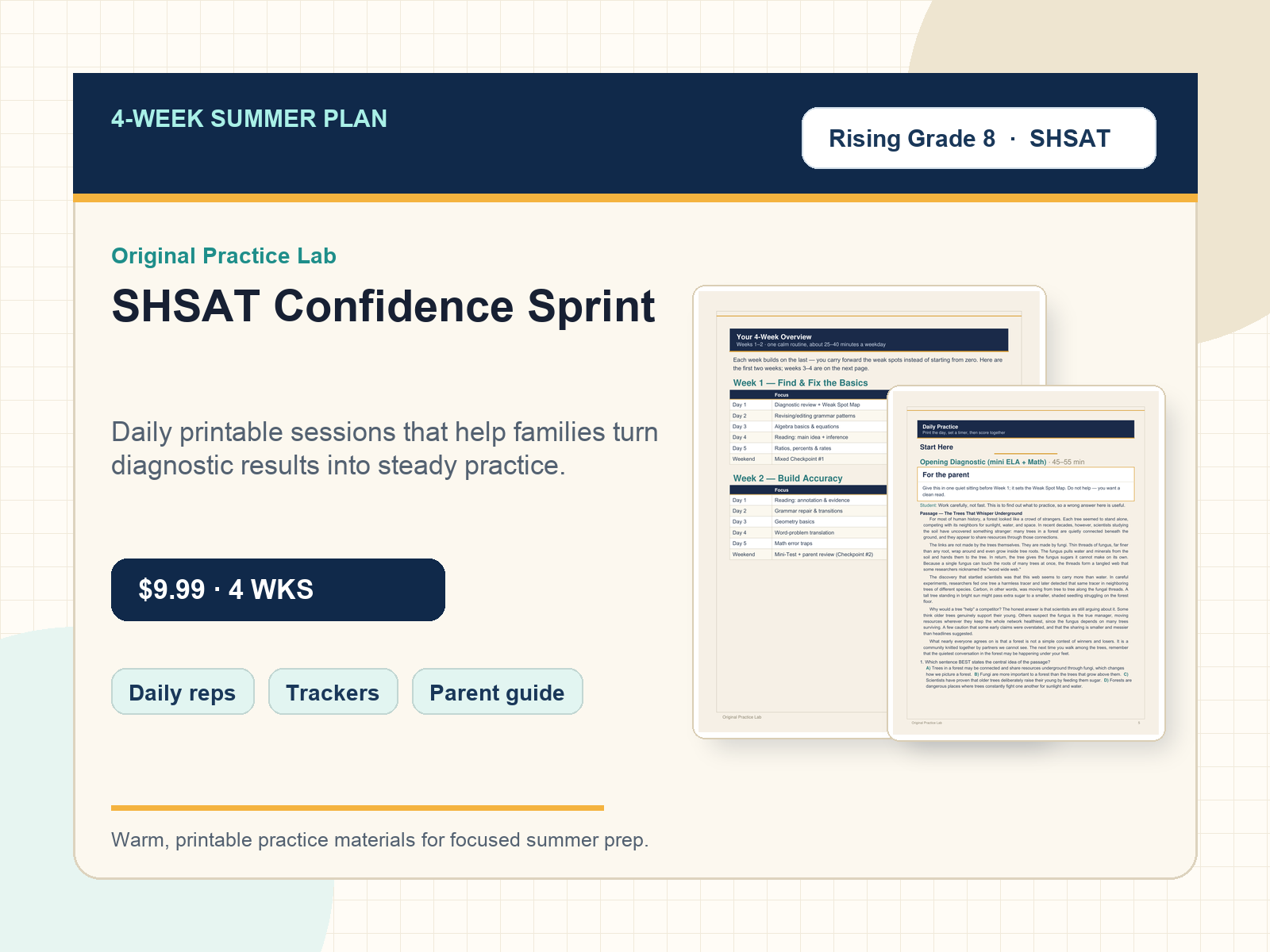
Use the Diagnostic First, Then Build a 4-Week Plan
For most families, the cleanest summer path is one printable diagnostic, followed by short daily ELA and math practice where the child actually needs it.
Questions Parents Ask
What is the work-rate setup trap?
It is the mistake of combining the times in a work problem instead of converting each worker, pipe, or machine into a rate and adding the rates.
How should a rising Grade 8 student check this?
Write each rate as part of the job per hour, add the rates, then invert the combined rate to find the time.
What should parents do after this mini-lesson?
Track whether the miss came from setup or arithmetic. If the student keeps averaging times, use more focused work-rate and ratio translation practice before another full test.
Is this affiliated with SHSAT, NYC schools, or any test publisher?
No. Original Practice Lab creates independent practice materials with original questions. The materials are not affiliated with, endorsed by, or sponsored by any test publisher, school district, or testing organization.