Daily SHSAT mistake lab
SHSAT Daily Mistake #9: The Geometry Diagram Assumption Trap
Geometry diagrams are useful, but they are not proof. Strong students use only the marks and statements given in the problem, not what the picture seems to suggest.
Free printable mini-lesson
Daily Mistake #9: The Geometry Diagram Assumption Trap
Print one SHSAT-style geometry question, let your child solve it from the given information only, then review why the picture cannot create facts.
- One focused geometry diagram question
- Answer key with a parent-friendly explanation
- Next-step links to the 8-mistake checklist and diagnostic
Download printable PDF
Why This Mistake Matters
Many students treat a clean geometry drawing as if it includes hidden facts. A segment looks split in half, two angles look equal, or a shape looks like a rectangle.
On a test, appearance is not enough. Unless the problem gives a mark, measurement, or statement, the student cannot assume equal lengths, a midpoint, perpendicular lines, parallel lines, or a special angle.
The Student Move
Circle the facts that are actually given. Then ask: did the problem tell me this, or did I infer it from the picture?
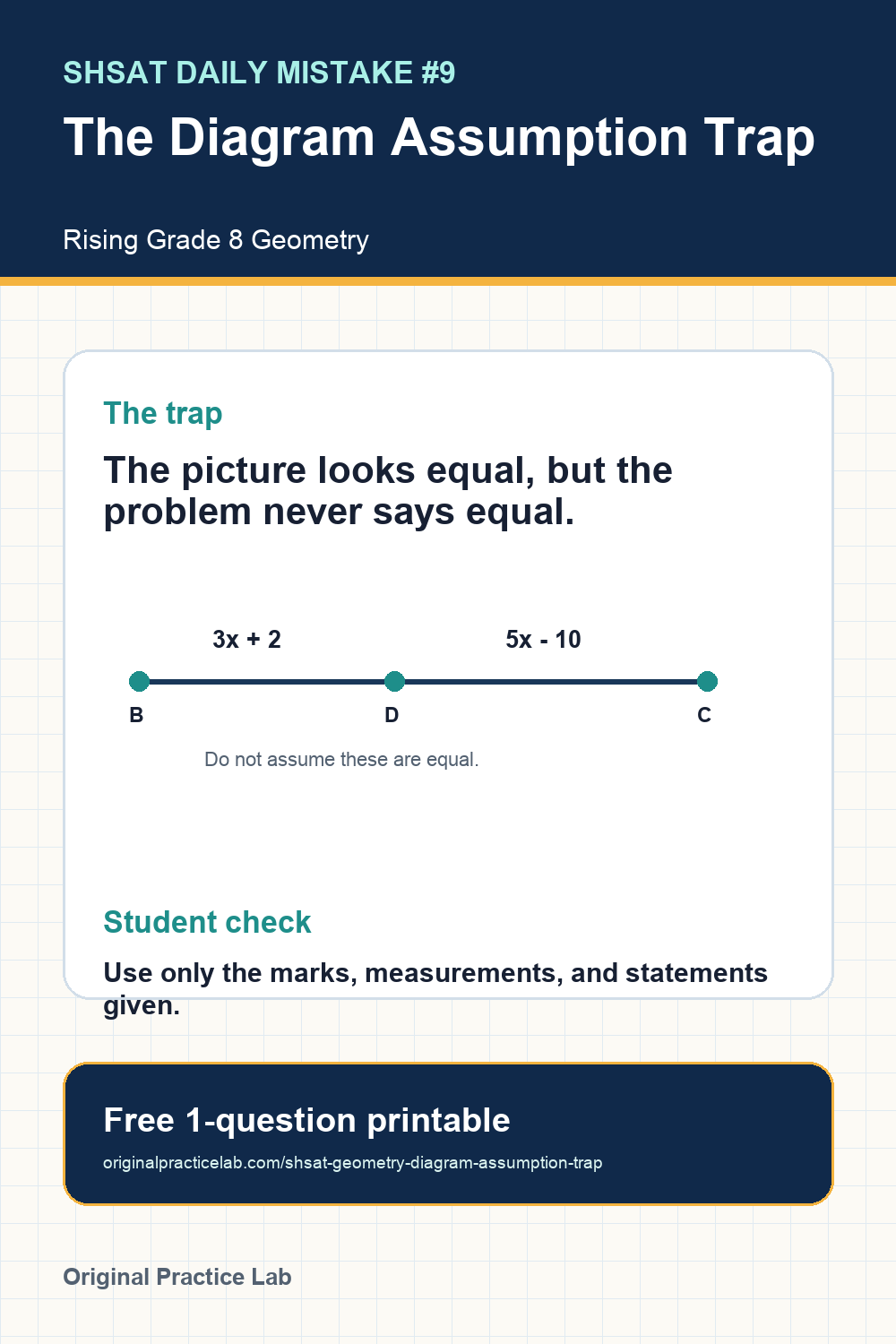
If a diagram shows point D on segment BC and gives lengths for BD and DC, you may add the parts to get BC. You may not set BD equal to DC unless the problem says D is the midpoint or marks the pieces equal.
One-Question Practice
Question: Point D lies on segment BC. The diagram makes BD and DC look similar in length. BD is 3x + 2 and DC is 5x - 10. No other information is given. Which expression represents BC?
Correct answer: 8x - 8.
Why: BC is the whole segment, so BC = BD + DC = (3x + 2) + (5x - 10) = 8x - 8. The drawing does not say D is the midpoint, so you cannot set 3x + 2 equal to 5x - 10.
What to Watch For Next
If your child misses this, the issue is not only geometry. It is evidence discipline: using what is given, not what looks plausible.
Have them write a short 'given facts only' list before solving the next geometry item. If this pattern repeats, use the 8-mistake checklist and weak-spot tracker before adding another full practice test.
Recommended next step
Use the Diagnostic First, Then Build a 4-Week Plan
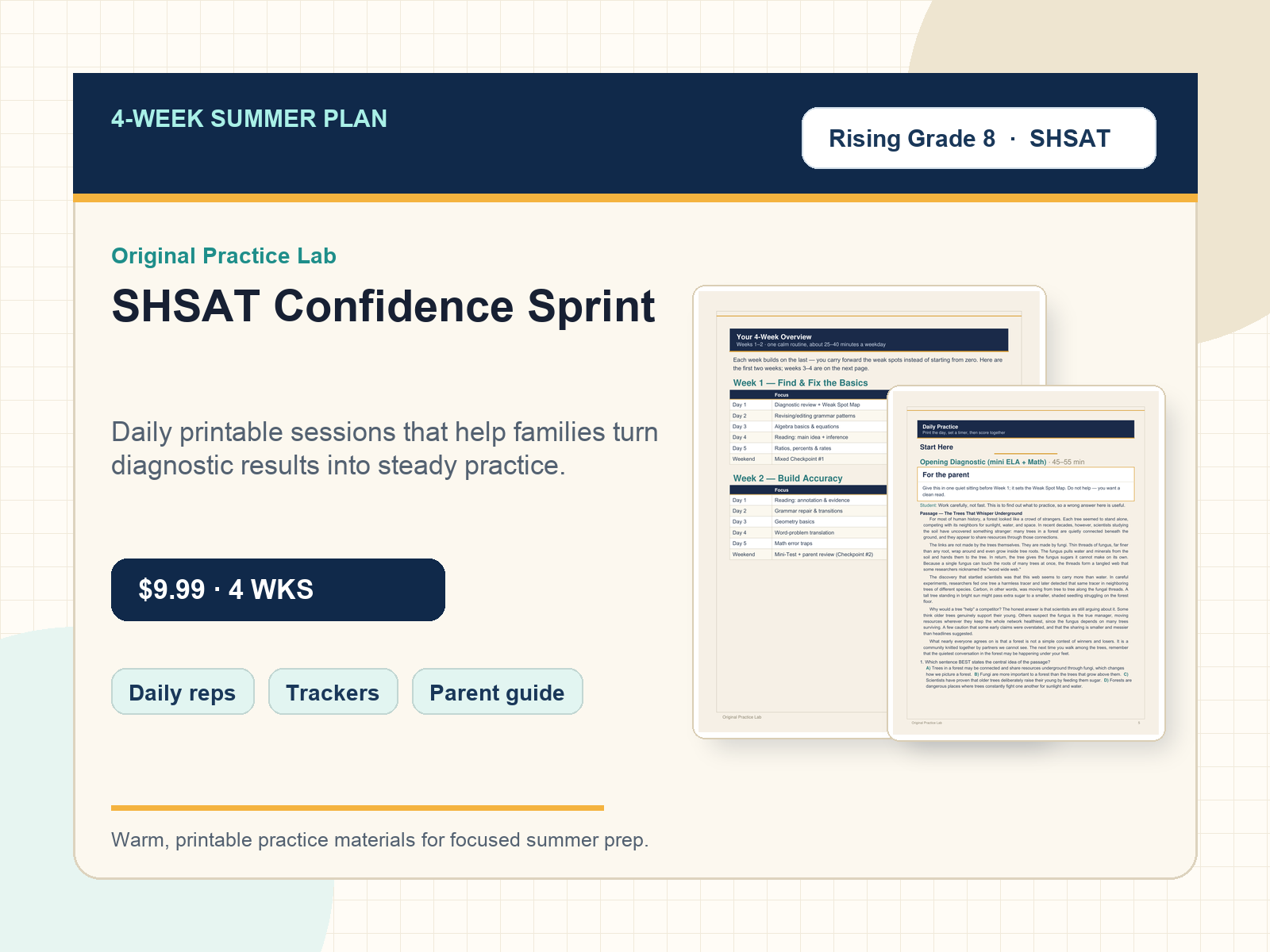
For most families, the cleanest summer path is one printable diagnostic, followed by short daily ELA and math practice where the child actually needs it.
Questions Parents Ask
What is the geometry diagram assumption trap?
It is the mistake of assuming equal lengths, midpoints, right angles, parallel lines, or special shapes because the drawing appears that way, even when the problem does not state or mark it.
How should a rising Grade 8 student check this?
List the facts that are actually given before solving. If a fact only comes from how the picture looks, do not use it.
What should parents do after this mini-lesson?
Ask the student to explain which facts were given and which facts were assumed. If diagram assumptions repeat, add this category to the weak-spot tracker.
Is this affiliated with SHSAT, NYC schools, or any test publisher?
No. Original Practice Lab creates independent practice materials with original questions. The materials are not affiliated with, endorsed by, or sponsored by any test publisher, school district, or testing organization.