Start With a Policy Kids Can Remember
A good ChatGPT homework policy should be short enough to repeat when everyone is tired. If the rule has twelve exceptions, children will not use it in the moment.
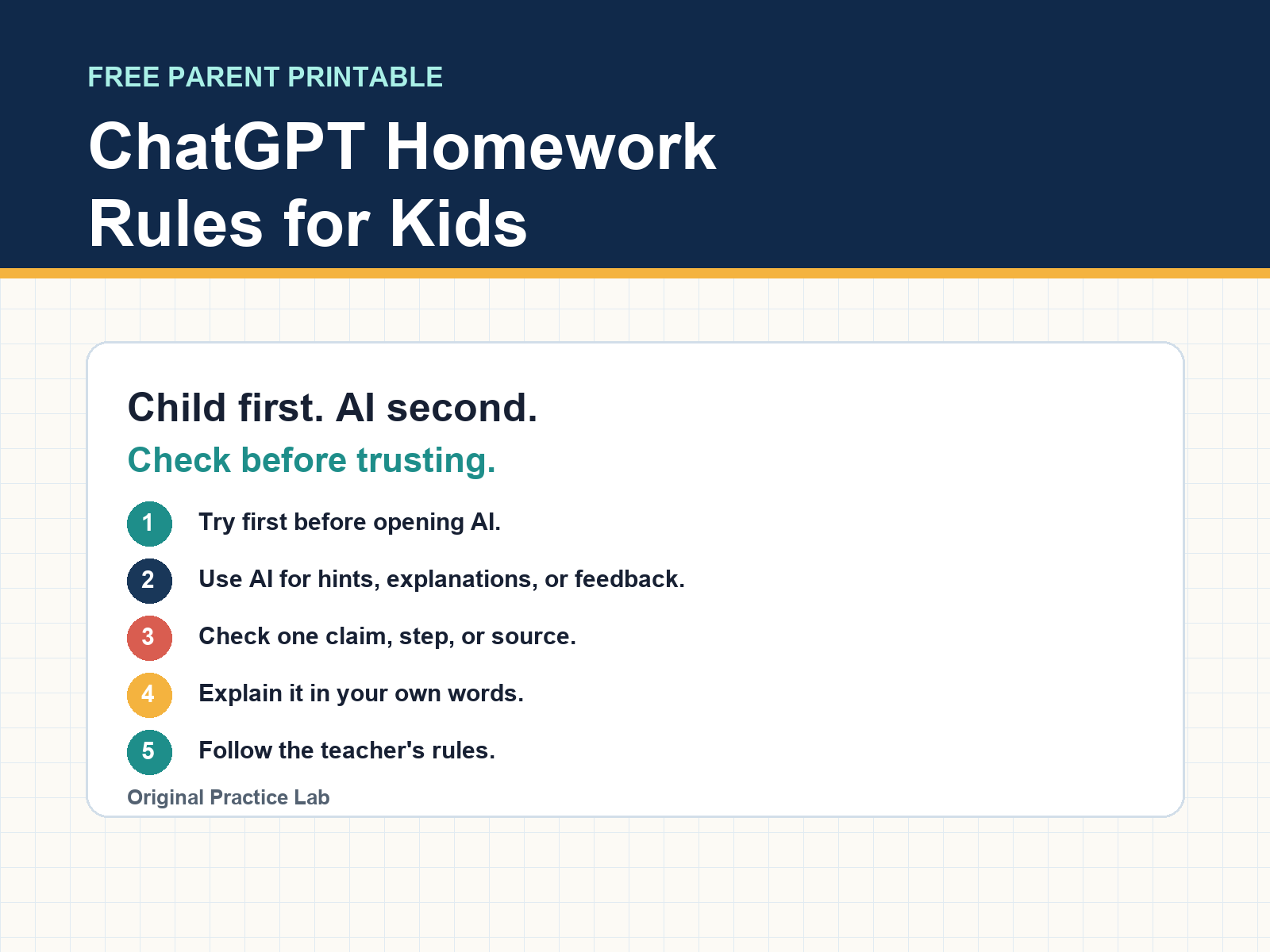
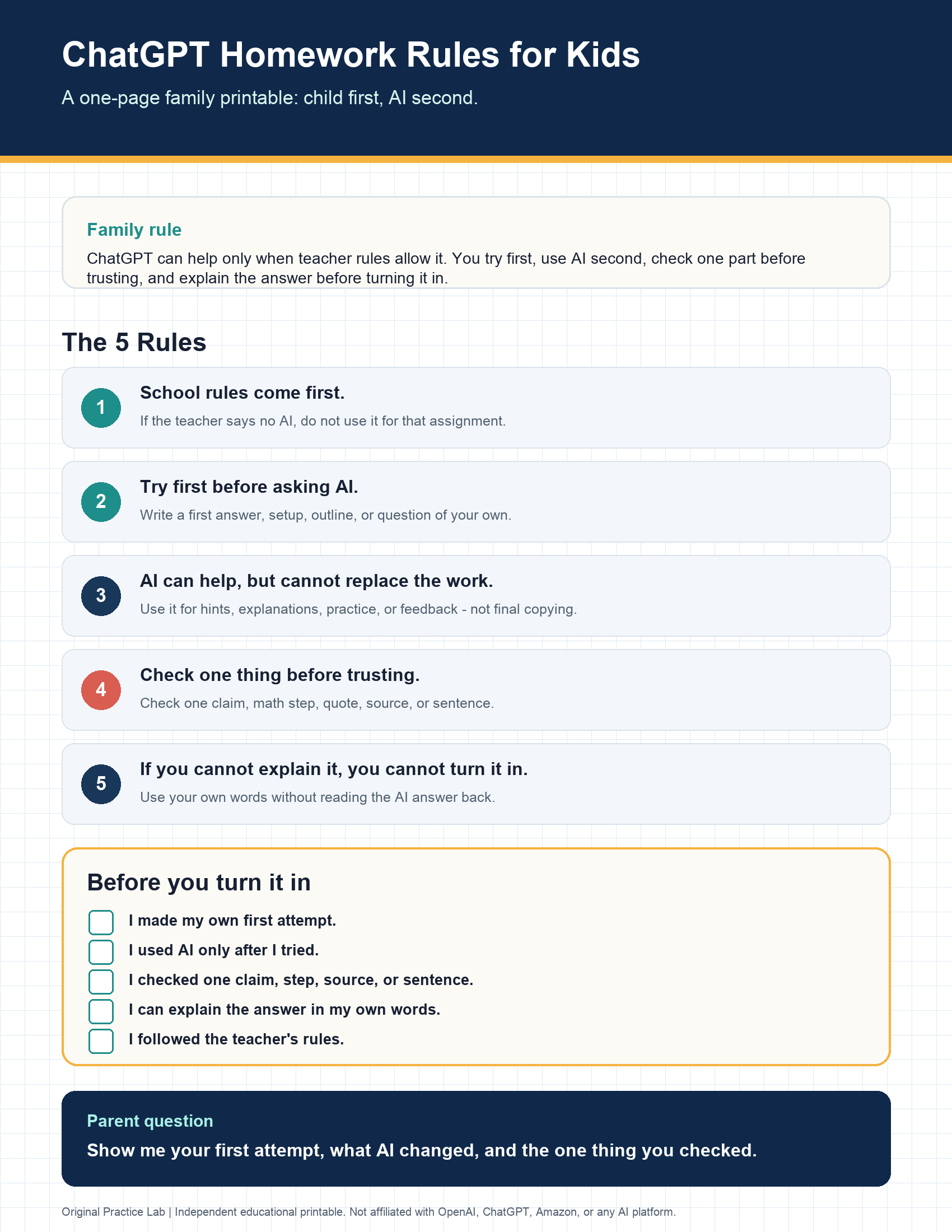
The simplest version is: school rules first, child first, AI second, no hidden copying, and check one thing before trusting.
That policy does not ban AI completely. It also does not hand homework to AI. It gives the child a clear way to use a powerful tool without losing the thinking practice homework is supposed to create.
Rule 1: School Rules Come First
If the teacher says no AI for a specific assignment, the family rule should match the teacher's rule. A parent policy should not teach children to route around classroom expectations.
If the teacher allows AI, ask what kind of use is allowed. There is a big difference between asking for a hint, asking for grammar feedback, asking for an outline, and submitting AI-written work.
When the rule is unclear, tell the child to ask the teacher. That is part of the learning habit too: know the boundary before using the tool.
Rule 2: The Child Makes a First Attempt
Before opening ChatGPT, the child must put something on the page: a setup, a rough sentence, a guess, an outline, a question, or a note about what feels confusing.
The first attempt does not need to be good. It only needs to be real. This protects the moment when the child has to retrieve, choose, struggle, and decide.
A useful family sentence is: you can ask AI after you have something of your own to compare it with.
Rule 3: AI Can Help, But It Cannot Replace the Work
Allowed uses might include asking for a hint, asking for another explanation, checking whether a step makes sense, finding unclear wording in a draft, or generating one practice problem.
Not allowed uses include copying final answers, submitting AI-written paragraphs as the child's own work, hiding AI use, or using ChatGPT so the child does not have to read, solve, or explain.
The distinction is not whether AI appeared. The distinction is whether the child still owns the thinking and the final answer.
Rule 4: One Check Before Trusting
Every time a child uses ChatGPT for homework, ask for one check. Not five checks. Not a long research project. Just one.
For math, check one step. For reading, check one claim against the passage. For science or history, check one fact against the textbook or a trusted source. For writing, check whether one suggested sentence still sounds like the child's own voice.
This rule matters because AI answers often sound finished. The one-check rule keeps the child in the role of judge.
Rule 5: The Child Must Be Able to Explain the Answer
After AI helps, ask: can you explain this without looking at the ChatGPT response?
If the child cannot explain the answer, the AI did too much. The next step is not punishment. The next step is to go back and ask for a hint, a smaller explanation, or a practice problem instead of a finished answer.
This rule is especially useful for math, grammar, and reading comprehension because it quickly reveals whether AI supported learning or replaced it.
A Simple Family Policy You Can Copy
Here is a parent-friendly version: In our family, ChatGPT can help with homework only when the teacher's rules allow it. You must try first, use AI second, and check one part before trusting it. You may use AI for hints, explanations, practice, and feedback. You may not copy final answers, hide AI use, or submit AI-written work as your own. If you cannot explain it, you cannot turn it in.
This policy is intentionally plain. It does not require parents to understand every AI tool. It keeps attention on the part that matters most: whether the child is still thinking.
How to Enforce the Policy Without Turning Homework Into a Fight
Ask for evidence of process, not a confession. Show me your first attempt. Show me what AI changed. Show me the one thing you checked.
If the child used AI badly, reset the task: write your own version first, then use AI only for a hint or feedback. The aim is to repair the learning loop, not to make AI a forbidden object.
If the child used AI well, name the good habit: you tried first, used it as a second opinion, and checked before trusting. That is the pattern to reinforce.
Practice the Rule Before the Next Assignment
The easiest time to teach an AI rule is not during a real homework crisis. Practice once when nothing is due.
Give your child a short AI-style answer and ask: would you trust it, hold on, or say not so fast? Ask for one reason. Then check the reveal together.
That small practice makes the family policy feel concrete. The child is not only hearing a rule. They are rehearsing the judgment habit the rule depends on.