First, Separate School Rules From Thinking Habits
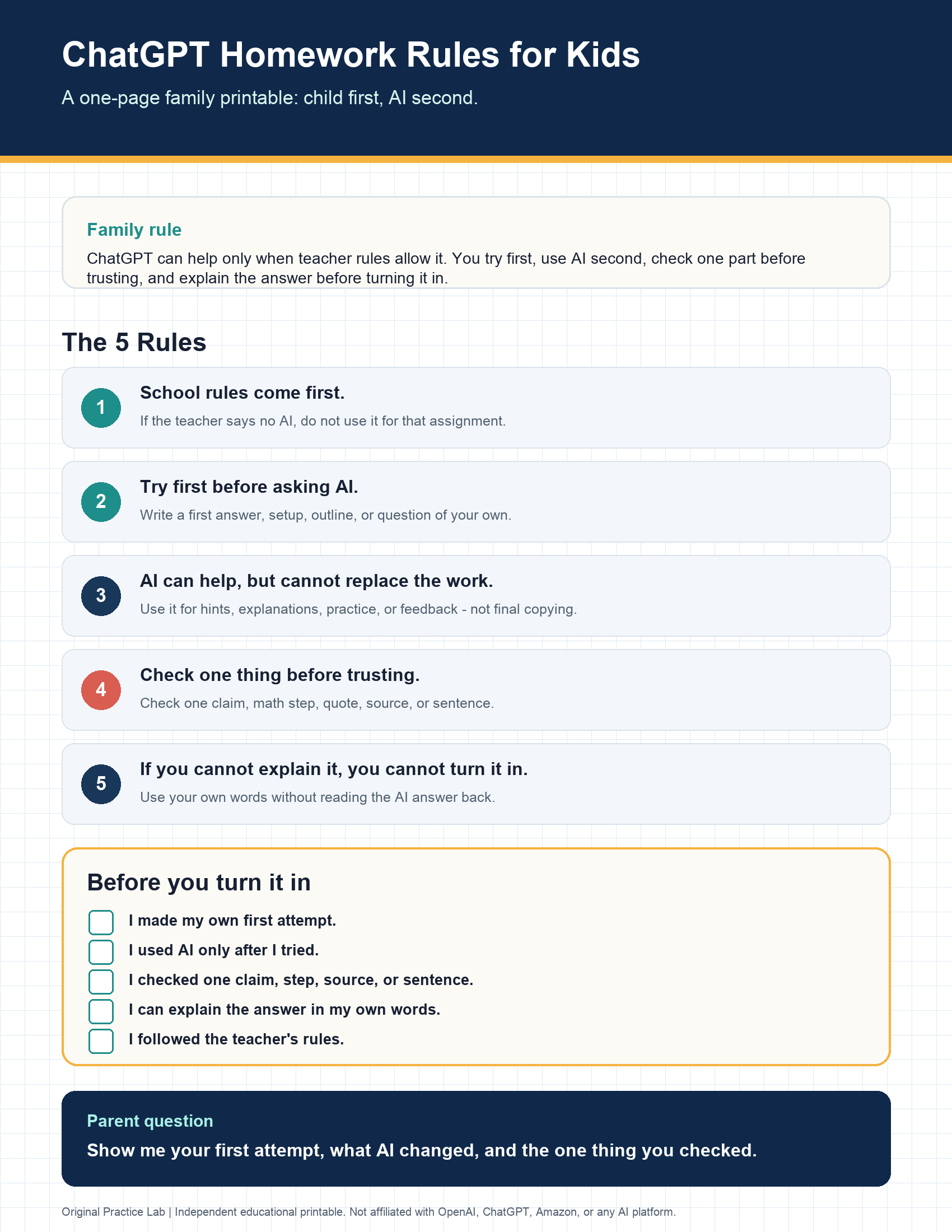
If a school or teacher says students may not use ChatGPT for an assignment, that rule comes first. Parents should not help a child work around the teacher's policy.
But many homework situations are less clear. A child may use ChatGPT to explain a math step, summarize a reading, generate essay ideas, check grammar, or simply get the final answer. Those are not the same behavior.
The parent job is to separate two questions: what does the assignment allow, and is my child still doing the thinking? The first is a school-rule question. The second is a learning question.
The Risk Is Not Just Cheating
Cheating is the obvious worry, but it is not the only one. A child can follow the rules and still become too passive if every hard moment gets outsourced to a chatbot.
Homework is useful because it creates a small struggle: remember the rule, choose a strategy, make a first attempt, notice the mistake, and revise. If ChatGPT gives a complete answer before the child has tried, that practice disappears.
The habit to protect is simple: my thinking comes first. AI can help after I have made an attempt.
Use a Traffic-Light Rule for ChatGPT Homework
A simple family rule can help: red, yellow, green.
Red uses are not okay: copying a final answer, submitting AI-written paragraphs as your own, hiding AI use when the teacher banned it, or using ChatGPT to avoid reading the assignment.
Yellow uses need adult or teacher judgment: asking for essay ideas, getting feedback on a draft, checking a math explanation, or using AI to simplify a hard passage. These can help, but only if the child has already tried and still owns the final work.
Green uses are usually safer: asking for a practice problem, asking for a hint, asking for vocabulary help, or asking AI to explain why the child's answer may be wrong. Even then, the child should check before trusting.
The Homework Rule: Child First, AI Second
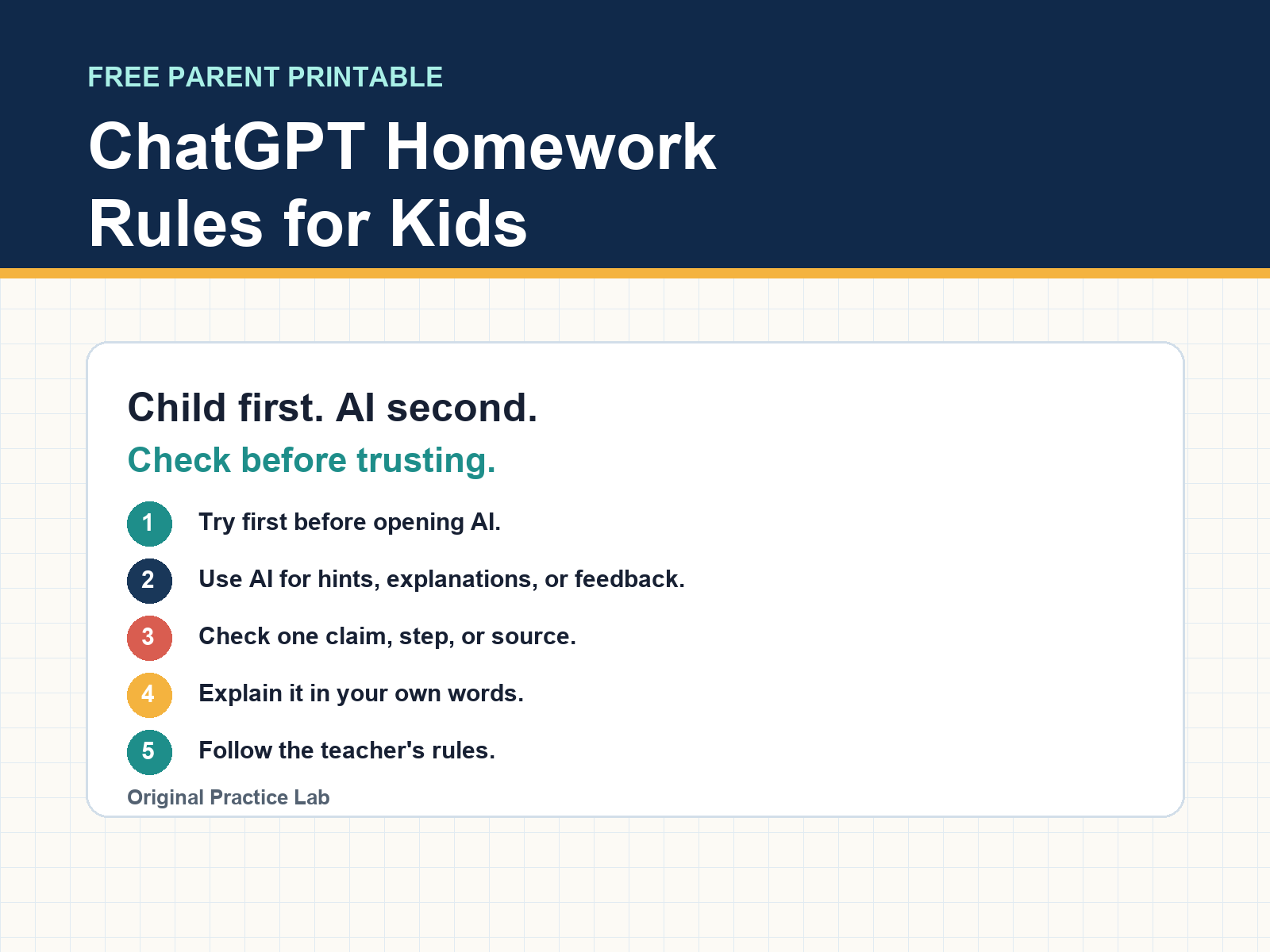
The most practical rule is: child first, AI second.
Before opening ChatGPT, the child writes something: a first answer, a prediction, a problem setup, an outline, or one sentence explaining what they do not understand. It does not have to be perfect. It just has to be theirs.
Then AI can act as a second opinion. It can explain a missed step, offer a hint, compare two outlines, or point out a weak sentence. The child's first attempt keeps the thinking in the child's hands.
If your child says, but ChatGPT can do it faster, the answer is: yes, and that is why we use it second. Fast answers are useful only after you have something to judge them against.
What Parents Can Say
Try this script: I am not saying you can never use ChatGPT. I am saying you cannot let it be the first or final thinker. Show me your first attempt, then we can use AI to compare, explain, or check.
For math, say: write the setup first. Then you can ask ChatGPT where your setup might go wrong.
For writing, say: write your own rough paragraph first. Then you can ask ChatGPT which sentence is unclear or what question a reader might still have.
For reading, say: read the passage first and write one sentence about what you think it means. Then you can ask ChatGPT to give a second explanation and compare it with yours.
Teach Kids to Check One Thing
Parents do not need to turn every ChatGPT homework moment into a research project. One check is enough to build the habit.
Ask your child to choose one claim, one step, or one sentence from the AI answer and check it. Can they find it in the textbook? Does it match the passage? Does the math step follow from the previous line? Does the teacher's rubric allow that kind of help?
The check should be small and repeatable. The goal is not to prove that AI is bad. The goal is to make verification automatic.
Do Not Make AI the Homework Police
It is tempting to use AI to catch whether your child cheated. That may be necessary in rare cases, but it should not become the main family pattern.
If every AI conversation becomes an accusation, the child will hide more. A better long-term approach is to make the acceptable uses clear and give the child a routine for using AI honestly.
The question should be: did you think first, use AI second, and check before trusting? That question is easier to repeat than a fight about whether AI is allowed at all.
A 10-Minute Practice Before the Next Homework Fight
Do one low-stakes practice round when there is no assignment due. Give your child a short AI-style answer and ask: would you trust this, hold on, or say not so fast?
Ask for one reason before showing the reveal. Then check the answer together. This turns AI judgment into a skill rather than a punishment.
That is the reason Original Practice Lab built Catch the AI's Lie. The activity lets kids practice the exact homework habit parents want: pause, judge, check, and decide before accepting a confident answer.
The Goal Is Calibrated Trust
The goal is not to teach kids that ChatGPT is useless. The goal is to teach them that a fluent answer still needs judgment.
Sometimes the AI will be right. Sometimes it will be partly right. Sometimes it will be confidently wrong. A child who can tell the difference is much safer than a child who simply hears AI is bad and then uses it secretly.
A good family policy gives kids permission to use AI as a tool while keeping responsibility where it belongs: with the learner.