What an AI Homework Policy Template Should Do
A useful AI homework policy template should be short enough for a child to remember and concrete enough for an adult to use during a real assignment.
The policy should answer five questions: what do school rules say, what must the child do before using AI, what AI help is allowed, what uses are not allowed, and what must be checked before turning work in.
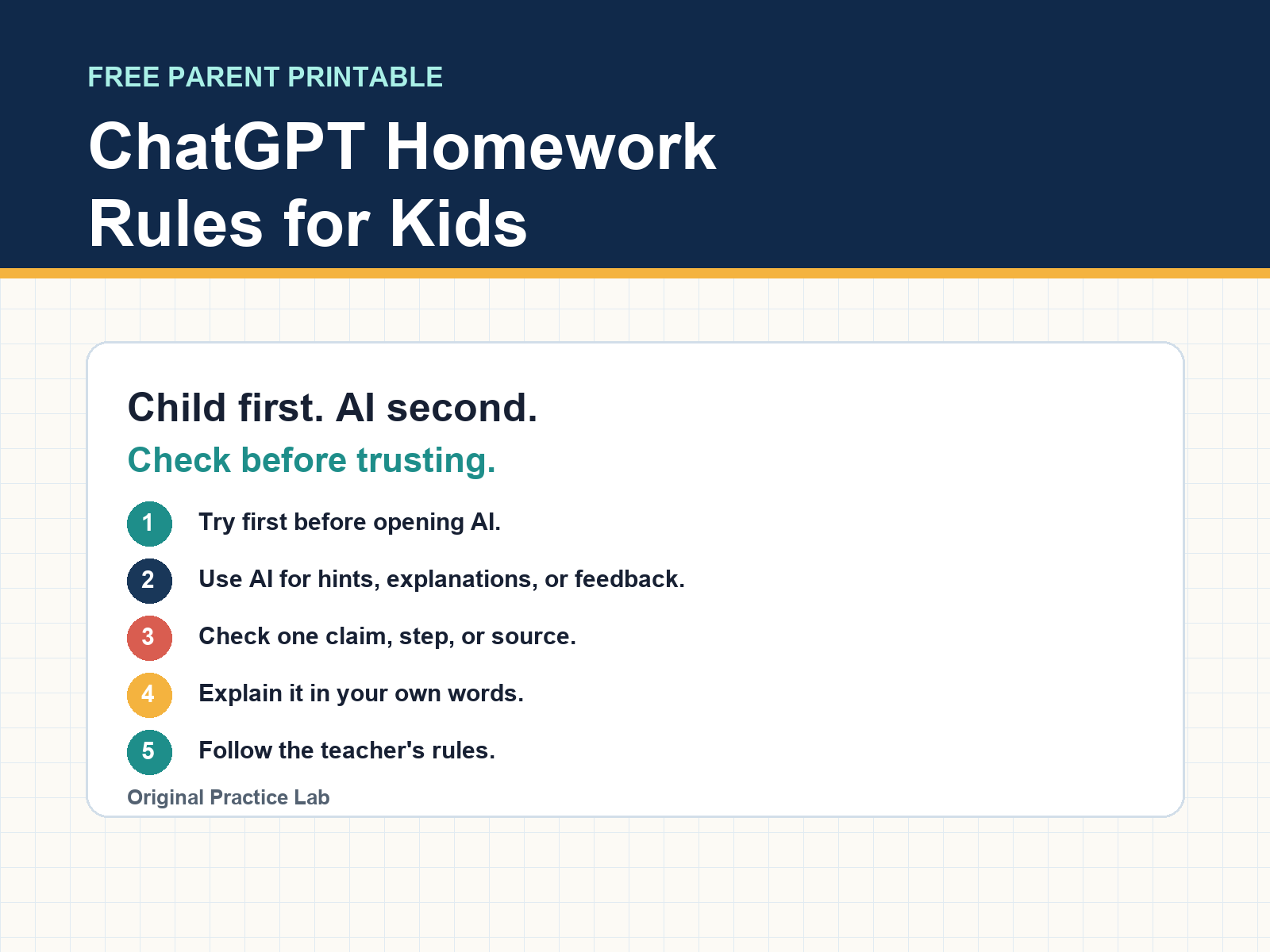
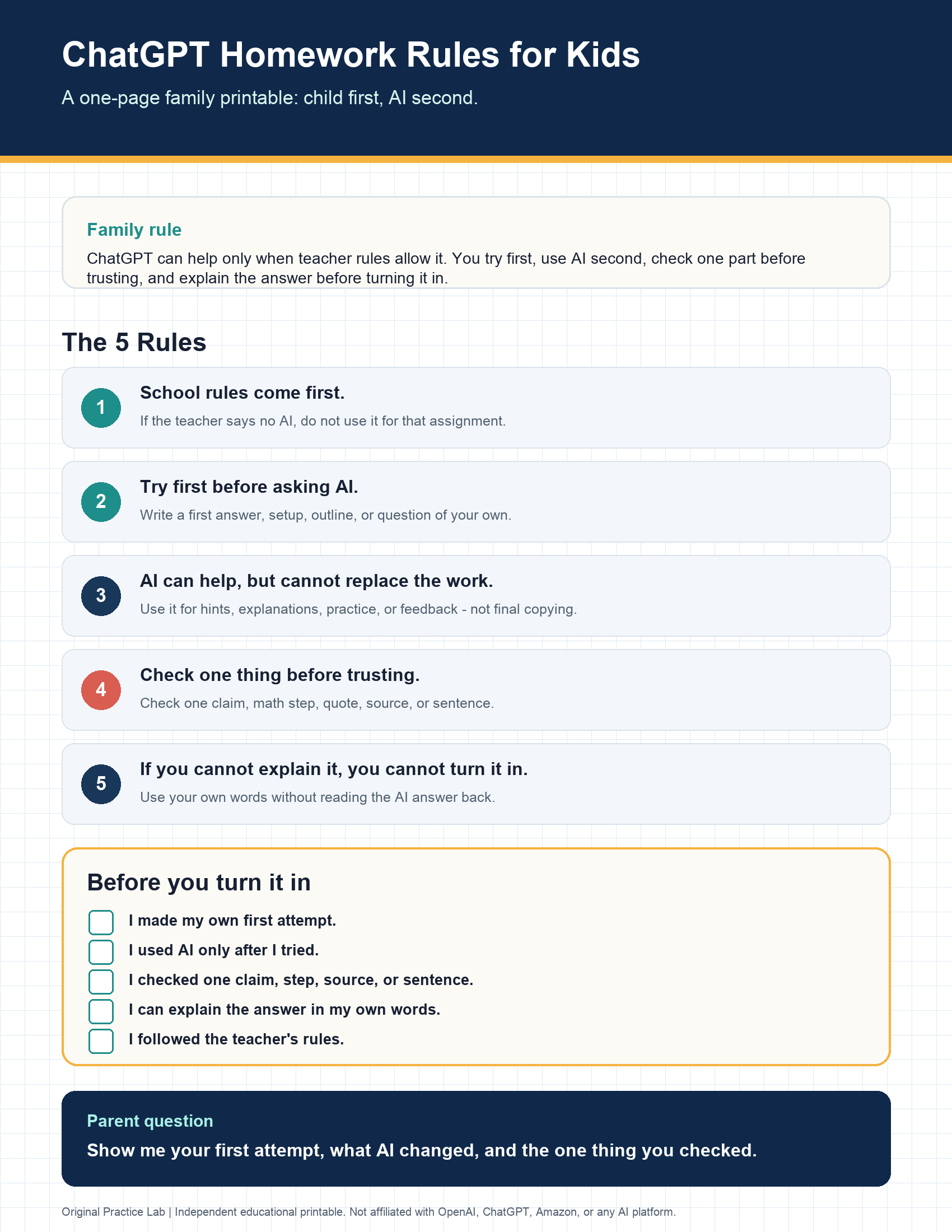
That is why the best first version is not a long technology contract. It is a visible homework rule: school rules first, child first, AI second, one check before trusting, and the child must be able to explain the final answer.
A Simple AI Homework Policy You Can Copy
In our family or classroom, AI can help with homework only when the teacher's rules allow it. The student must make a real first attempt before using AI: a setup, outline, draft sentence, answer, or question in their own words.
AI may be used for hints, explanations, brainstorming, feedback, or extra practice when those uses fit the assignment. AI may not be used to copy final answers, hide AI use, skip reading or solving, or submit AI-written work as the student's own.
Before trusting an AI answer, the student checks one claim, step, source, or sentence. If the student cannot explain the answer without the AI response in front of them, the work is not ready to turn in.
Use a Generator When One Template Is Too Generic
A single template is a good starting point, but families and classrooms often need slightly different wording. An upper-elementary policy should be short and parent-guided. A middle-school policy can ask for more independence. A tutor or homeschool policy may need the adult review step to be visible.
The free AI homework policy generator lets you choose the setting, allowed uses, main priority, and disclosure sentence. It then creates a printable one-page policy locally in the browser.
The generator does not ask for a child's name, school, email, or assignment details. It is meant to produce a simple rule, not collect private homework information.
What to Allow
Allowed AI uses should support thinking after the student has tried first. Common allowed uses include asking for a hint, asking for a different explanation, brainstorming possible essay angles, getting feedback on a draft, or creating extra practice questions.
The important phrase is after trying first. If AI gives the full answer before the child has made an attempt, the learning loop can disappear.
A good rule is: you can ask AI after you have something of your own to compare it with.
What Not to Allow
The policy should clearly ban copying final answers, submitting AI-written paragraphs as the child's own work, hiding AI use when disclosure is required, and using AI to avoid reading the assignment.
These boundaries matter because many AI homework problems are not about the tool itself. They are about ownership. Did the child do the thinking, or did the tool replace the thinking?
If the child cannot explain the answer, the policy should send them back to a smaller help request: a hint, one step, one example, or one question to practice.
Add One Disclosure Sentence
A simple disclosure sentence makes the policy easier to follow. For families, use: I used AI for help after making my own first attempt, and I checked the final answer myself.
For classrooms, use: I used AI only in the way this assignment allowed. I can explain what I wrote and what I checked.
If AI was not used, the disclosure is simple too: No AI was used for this assignment. The point is not to turn every homework page into paperwork. The point is to make honest use normal and visible.
Print the Policy Before Homework Gets Tense
The best time to introduce an AI homework policy is before a late-night assignment, not during a conflict.
Print the policy, read it once with the child, and practice on a low-stakes example. Ask the child to make a first attempt, use AI as a second opinion, check one part, and explain the final answer.
That short rehearsal turns a rule into a routine. When real homework arrives, the family is not inventing the boundary from scratch.
Template, Kit, and Practice Activity
Start with the free AI homework policy generator if you need a quick one-page rule. Use the full AI Homework Policy Kit if you also want a student checklist, mini answer-audit activity, and adult implementation guide.
If your child needs practice judging confident AI answers, use the Catch the AI's Lie free sample after the policy is in place. The policy sets the boundary. The answer-audit activity trains the habit behind the boundary.
The sequence is simple: write the rule, make the checklist visible, then practice checking one AI answer before trusting it.